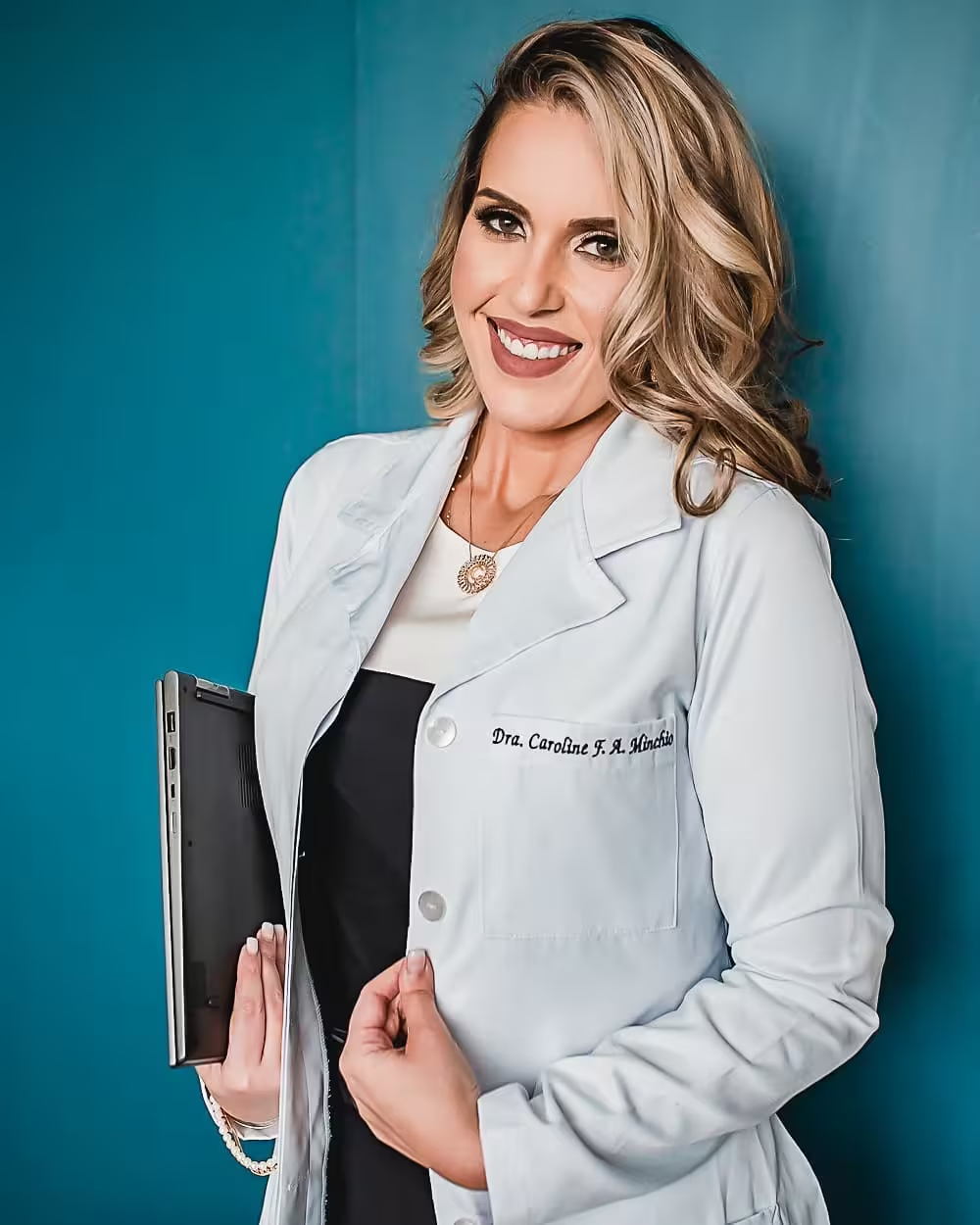
Hello! If you are looking for a treatment that goes beyond immediate filling and truly transforms the quality of your skin from the inside out, collagen biostimulators may be the answer.
I prepared this comprehensive guide to explain, based on science, what these powerful actives are, how they act in your body, what the expected results are, and how they can help you regain firmness and skin vitality naturally and lastingly.
Introduction: What are Collagen Biostimulators?
Imagine planting a seed that, over time, transforms into a strong and beautiful plant. Collagen biostimulators work similarly: they are injectable substances that, instead of just occupying a space (like fillers), stimulate your own body to produce more collagen and elastin.
With natural aging, starting around 25-30 years old, we lose about 1% to 1.5% of our collagen per year. This process leads to skin laxity, loss of facial contour support, and the appearance of fine lines. Biostimulators act exactly there: they create a controlled micro-inflammation in the skin, activating fibroblasts (our building cells) to get back to work, producing a new, firm, and organized collagen matrix.
The result is thicker, firmer, more elastic skin with a naturally rejuvenated appearance that builds up gradually and can last for years.
🔗 Return to our Homepage or learn more by visiting the official Collagen Biostimulators treatment page.
Chapter 1: The Basics (Types and Mechanism of Action)
1. What exactly are collagen biostimulators?
2. What are the main types of biostimulators available?
- Poly-L-lactic acid (PLLA - Sculptra®): Stimulates collagen production gradually and intensely, with very natural and long-lasting results (up to 2 years or more).
- Calcium Hydroxylapatite (CaHA - Radiesse®): In addition to stimulating collagen, it has an immediate filling effect due to its carrier gel, being excellent for areas that need volume and support.
- Polycaprolactone (PCL - Ellansé®): Offers immediate results and prolonged stimulation, with durability varying depending on the chosen type (from 1 to 4 years).
- Diluted Calcium Hydroxylapatite (Diluted Radiesse® or Hyperdilute): Used for body biostimulation and superficial facial biostimulation, improving skin texture over large areas.
3. How does each of them act differently in the body?
- PLLA is made up of microspheres that are gradually absorbed, leaving behind new, structured collagen.
- CaHA forms a matrix that serves as a scaffold for cells to attach to and produce collagen, and is later metabolized into calcium and phosphate.
- PCL also uses microspheres, but its longer duration is due to the slower absorption time of the substance.
4. Are biostimulators permanent?
5. What is the fundamental difference between a biostimulator and a filler?
- Filler (Hyaluronic Acid): It's like putting a gel inside a wrinkle or an area with volume loss. The result is IMMEDIATE and more focused on volume replacement.
- Biostimulator: It's like fertilizing the soil. You don't see the result right away, but over time the plant (your skin) grows stronger. The result is GRADUAL and focused on improving the QUALITY, FIRMNESS, and SUPPORT of the skin as a whole.
6. Can they be combined?
Chapter 2: Indications and Body Areas
7. In which areas of the face are biostimulators most indicated?
- Cheekbones: To restore lost volume and support, creating a lifting effect.
- Jawline and chin: To define the facial contour and improve sagging.
- Temples: To fill the sunken region, common in aging.
- Malar region (near the nose): To smooth the nasolabial folds indirectly, by lifting the skin.
- Submental fullness (double chin): To improve skin firmness.
8. Does it work for body skin laxity?
- Buttocks: To improve firmness, skin texture (cellulite), and give a slight projection.
- Arms (inner region): To treat underarm laxity ("bat wings").
- Abdomen: To improve skin firmness, especially after pregnancy or weight loss.
- Thighs and inner thighs: To treat sagging and cellulite.
- Inner face of the knees: To improve localized laxity.
9. How does it act on cellulite?
10. Can I use a biostimulator for post-pregnancy sagging?
11. And for post-weight loss sagging?
12. Does it work for hand rejuvenation?
13. Can the treatment help with neck laxity?
Chapter 3: The Step-by-Step Procedure
14. What is the evaluation consultation like?
15. How is the application done?
16. Does the application hurt?
17. How long does the session last?
18. How many sessions are needed to see results?
- PLLA (Sculptra®): Usually, 2 to 3 sessions are recommended, with intervals of 30 to 45 days, for a complete and lasting result.
- CaHA (Radiesse®): Often, a single session already provides a good result, which can be supplemented with another session after a few months, if necessary.
- PCL (Ellansé®): Normally, one session is enough for the desired result, given its prolonged duration.
19. Is the result immediate?
- With PLLA and diluted CaHA for the body: The result is GRADUAL. You do not see an immediate difference because the skin needs time to produce collagen.
- With CaHA (Radiesse®) on the face and PCL (Ellansé®): There is an immediate effect due to the carrier gel, which gives instant volume. But the best result, with firmer skin, will come over time, after collagen stimulation.
20. When do I start seeing the first results?
Chapter 4: Pre and Post-Procedure Care
21. What are the pre-application care instructions?
- Avoid anticoagulant medications (Aspirin, anti-inflammatories) and supplements like omega 3, vitamin E, and ginkgo biloba for about 5 to 7 days.
- Avoid alcoholic beverages in the preceding 48 hours.
- Keep the skin well hydrated.
22. And after the application, what is the care?
- Massage: It is crucial to massage the treated area as directed (usually 5 minutes, 5 times a day, for 5 days). This helps distribute the product evenly and prevents the formation of nodules.
- Ice: Apply local ice in the first 24-48h to decrease swelling and bruising.
- Activities: Avoid intense physical exercises for 48-72h.
- Heat: Avoid direct sun exposure, saunas, and very hot baths in the first few days.
23. Why is massage so important?
24. Can I work normally afterwards?
25. When can I do physical exercises?
Chapter 5: Results and Durability
26. How long does the effect of biostimulators last?
- PLLA (Sculptra®): Results can last more than 2 years.
- CaHA (Radiesse®): Average duration is 12 to 18 months.
- PCL (Ellansé®): Depends on the chosen version, and can last from 1 to 4 years.
27. Is the result permanent or does the new collagen eventually fade?
28. What is the difference in result between a biostimulator and a surgical facelift?
Chapter 6: Side Effects, Risks, and Controversies
29. What are the most common side effects?
- Swelling, redness, pain at the application site (last a few days).
- Small bruises.
- Slight sensitivity to touch.
30. What are the rarer but possible adverse effects?
- Palpable or visible nodules: Small lumps under the skin, usually caused by inadequate technique or failure to massage. Most can be treated with more intense massage, product dilution, or, in rare cases, corticosteroids.
- Granulomas: Delayed inflammatory nodules of immunological cause. They are rare and treatable.
- Vascular occlusion (very rare): If the product is injected into a blood vessel. Therefore, careful technique and knowledge of anatomy are essential.
31. Is there a risk of allergy?
32. What should I do if a nodule appears?
Chapter 7: Contraindications and Myths
33. Who cannot undergo the treatment?
- Pregnant and breastfeeding women (as a precaution).
- People with active autoimmune diseases or on immunosuppressive treatment (medical evaluation required).
- Patients with active infection in the area to be treated.
- People with a known allergy to any of the formula's components.
34. Can I get it if I have an autoimmune disease (like lupus or Hashimoto's thyroiditis)?
35. Does the biostimulator thicken the skin?
36. Can the product be seen or felt under the skin?
37. Does a biostimulator cause facial fat loss?
Chapter 8: Combining with Other Treatments
38. Can I combine a biostimulator with botulinum toxin?
39. And with hyaluronic acid fillers?
40. Can I do laser or microneedling alongside it?
41. And with body procedures, like radiofrequency?
Chapter 9: Choosing the Professional and Results
42. How to choose the right professional to apply the biostimulator?
- Has a deep knowledge of anatomy.
- Has experience with different types of biostimulators.
- Gives you confidence and answers all your questions.
- Works in a safe environment with guaranteed products.
- Has a portfolio of natural results.
43. Can the biostimulator give an artificial look?
44. Can I see photos of results from other patients?
45. What is the cost difference between the types of biostimulators?
46. Is there a minimum or maximum age to get it done?
47. Can the treatment be done in winter?
48. How long after childbirth can I get it?
49. Does the biostimulator interfere with imaging exams?
50. What to expect from your consultation with me, Dr. Caroline?
I hope this guide has answered your questions about collagen biostimulators. Remember: information is the foundation for safe decisions and satisfactory results. I am here to walk with you on this self-care journey.
With care and dedication,
Dr. Caroline Minchio
Ready to invest in your skin?
Take the first step to regain firmness and vitality safely.